

At first glance, early education and higher education appear to sit at opposite ends of the learning spectrum. One serves children just beginning to understand the world; the other supports adults preparing to shape it. In practice, however, the most effective learning environments across both age groups share far more in common than their differences suggest.
At Charles Vincent George (CVG) Architects, our work in both early education and higher education has shown that while age plays a significant role in shaping how spaces function, the underlying intent remains consistent. A three-year-old and a college student experience the world in very different ways, and their environments must respond accordingly. Yet at every stage, successful learning spaces are rooted in the same principles: supporting curiosity, fostering connection, and creating environments where people feel comfortable, capable, and engaged.
Across early education and higher education alike, one of the strongest shared themes is the importance of offering spaces that feel genuinely livable. Learning does not happen only at a desk; it happens in environments where people feel at ease enough to settle in, recharge, and focus.
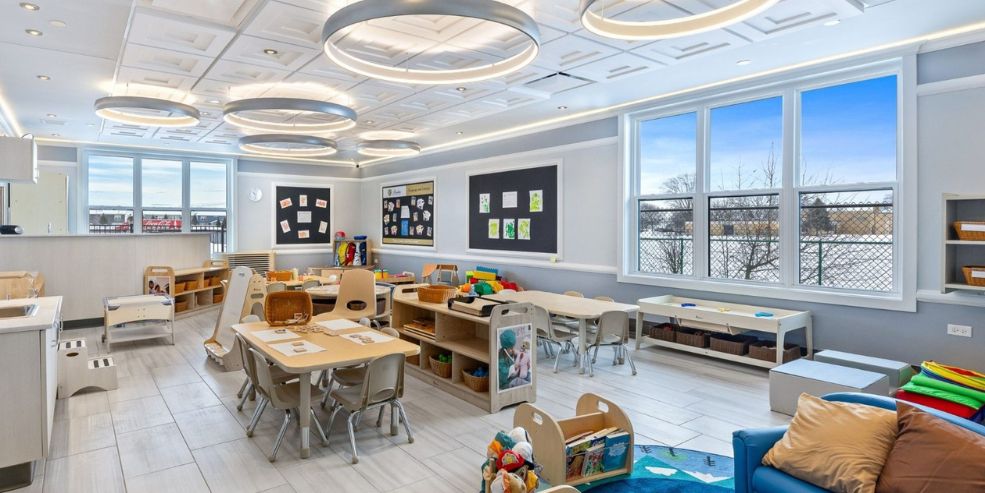
In early education, this often means spaces that feel closer to home than to an institution. Young children learn through movement, exploration, and routine, and their environments must support all of these. Classrooms are designed to accommodate a range of activities—from active play to quiet moments of rest. Napping is an essential part of early development, and thoughtful use of soft materials and flexible furnishings helps create environments that feel safe, supportive, and adaptable.
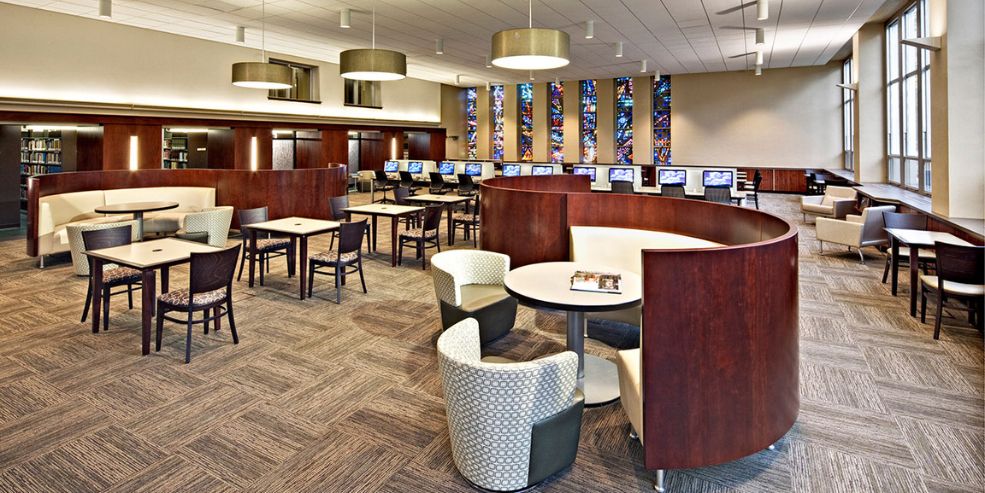
That same instinct appears at the other end of the educational spectrum. College students may not have scheduled nap time, but they gravitate toward comfortable, welcoming spaces. At St. Xavier University, we redesigned a library to accommodate this need. With a range of seating options, from individual study areas to relaxed, lounge-like settings, the space supports focused work, informal collaboration, and moments of rest. In many ways, the adult learner’s desire for a “living room” environment mirrors the needs of much younger students, simply expressed differently.
Learning is inherently social. Whether in a preschool classroom or on a university campus, people learn best when they feel connected to others and to their surroundings.
In early education, open layouts and clear sightlines help children feel supported while encouraging independence. In higher education, shared spaces play a vital role in building community beyond the classroom. Student centers, lounges, and informal study areas provide opportunities for collaboration, reflection, and connection.
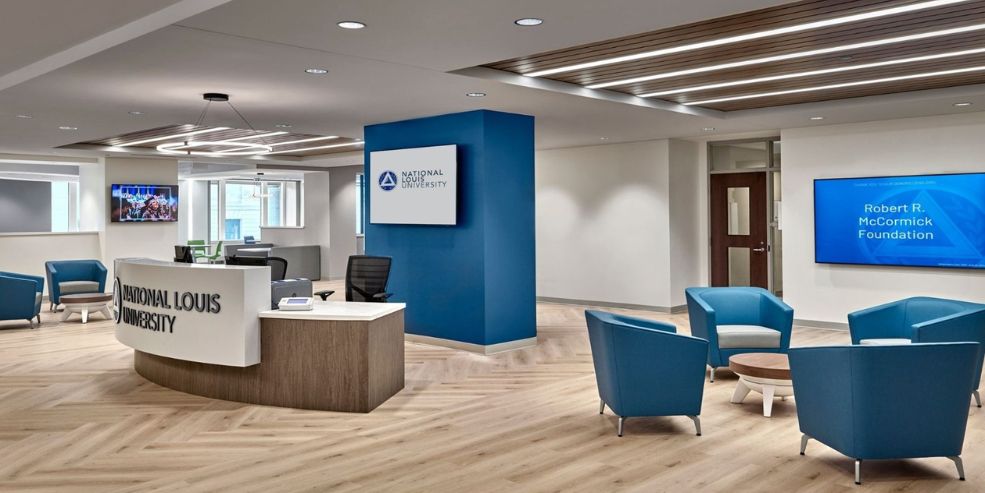
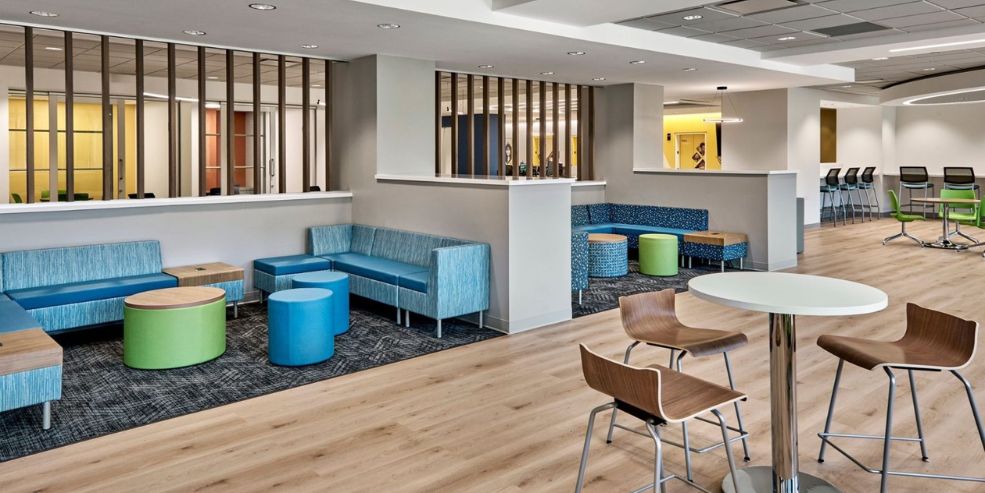
The transformation of the National Louis University Student Center illustrates this clearly. Once a closed, inward-facing space, it was reimagined as an open and welcoming hub for campus life. The space now takes full advantage of natural light that floods in from views over Millennium Park in downtown Chicago. A new coffee shop and a mix of social and study spaces support both focused work and spontaneous interaction, reinforcing the idea that learning extends beyond the classroom.
Technology plays a central role in shaping how learning happens today, but its value lies in how thoughtfully it is integrated. Across both early education and higher education, technology is most effective when it supports learning rather than dominating it.
In early education, technology is introduced intentionally and in age-appropriate ways. Tools such as smart boards support interactive learning while giving faculty a streamlined tool for delivering the curriculum, while classrooms continue to prioritize hands-on exploration, movement, and social development. The goal is balance—using technology to enhance learning without replacing the physical and sensory experiences that are essential at a young age.
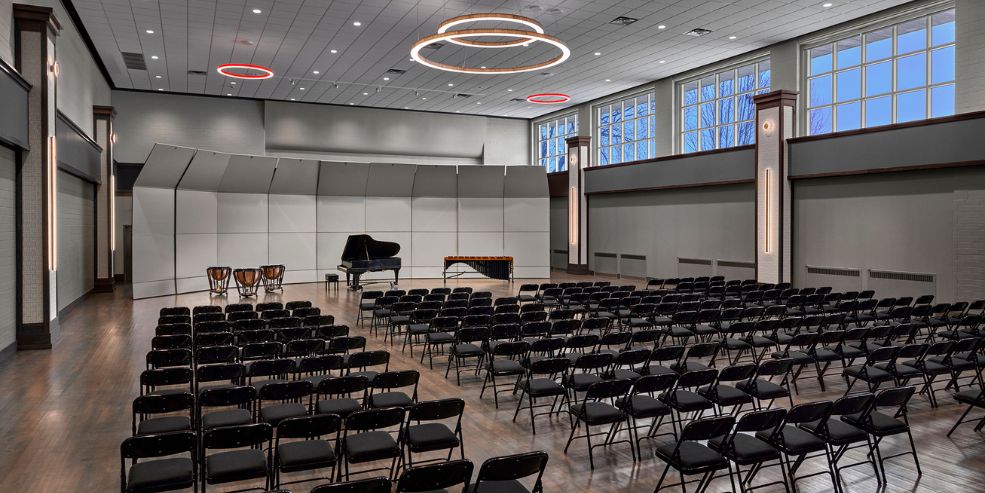
In higher education, technology becomes more deeply embedded in daily learning. Classrooms must support laptops, digital collaboration, and hybrid instruction, with infrastructure that allows for flexibility as teaching methods evolve.
Across both settings, the most successful spaces treat technology as an enabler that supports connection, creativity, and engagement without overwhelming the human experience.
Across all age groups, safety is fundamental to learning. While strategies differ by age, the goal remains the same: to create environments where students feel secure enough to focus, explore, and grow.
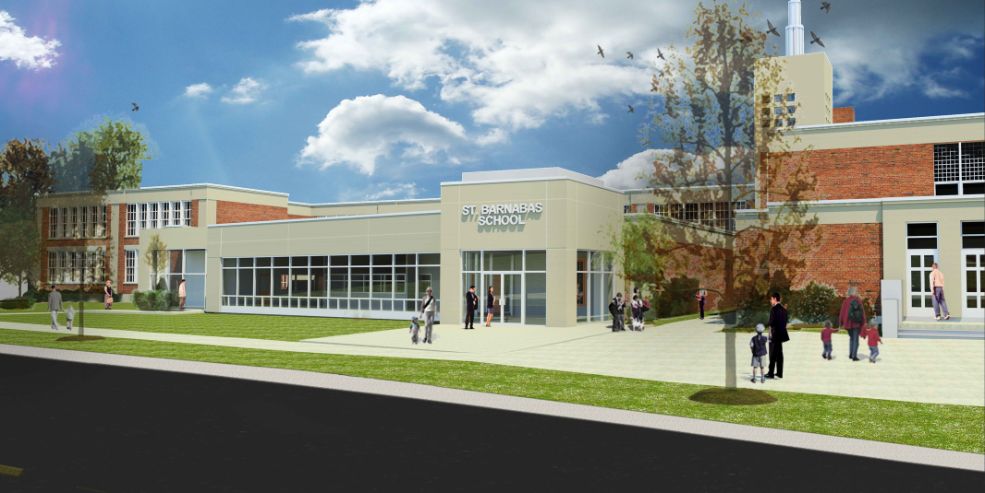
In early education settings such as St. Barnabas, safety is addressed through layered design strategies, including controlled entry points, clear sightlines, and thoughtful circulation that allows staff to monitor movement while maintaining a welcoming atmosphere. In higher education, safety often focuses on controlled access, classroom security, and well-lit circulation that supports visibility without feeling restrictive.
When thoughtfully integrated, these measures fade into the background, allowing learning and connection to take center stage.
Perhaps the strongest connection between early education and higher education is the understanding that learning is a lifelong process. Educational environments must evolve alongside the people who use them, and therefore, flexibility is paramount.
At CVG, we see design as an ongoing conversation between space and learner. Whether creating environments for young children discovering the world or for adults preparing to enter it, our goal is the same: to design spaces that support growth, adaptability, and connection over time.
When educational spaces are designed with intention, they actively shape the learning process. And across every stage of education, that thoughtful, human-centered approach makes all the difference.

.jpg)
